As the coach bus hums northbound and the Florida landscape slowly gives way to pine trees and familiar roads, there is a different kind of quiet among our sixth-graders. It is not the quiet of exhaustion, though there is some of that. It is the quiet of fullness. Of having seen something so large, so powerful, so historic, that words struggle to contain it.
This week in Florida was more than a field trip. It was the kind of week that tucks itself into memory.
Sitting in the front of the bus, I find myself thinking about childhood. About the moments that linger for decades. Growing up across the street from the U.S. Space & Rocket Center in Huntsville, Alabama, as a child of the Apollo era, I remember meeting an astronaut for the first time. I remember going to bed each night with the Saturn V illuminated by spotlights against the dark Alabama sky. My father worked during the years of Project Gemini and the Apollo program. The space program was not just history in a textbook. It was the backdrop of my childhood.
And today, standing with our sixth-graders at Kennedy Space Center, I realized they were living one of those moments.
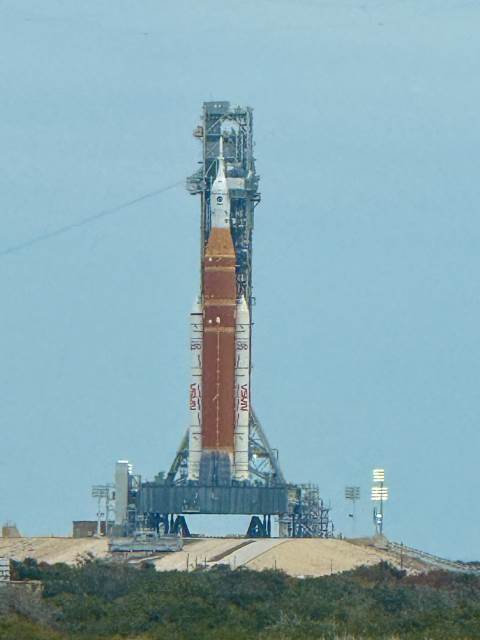
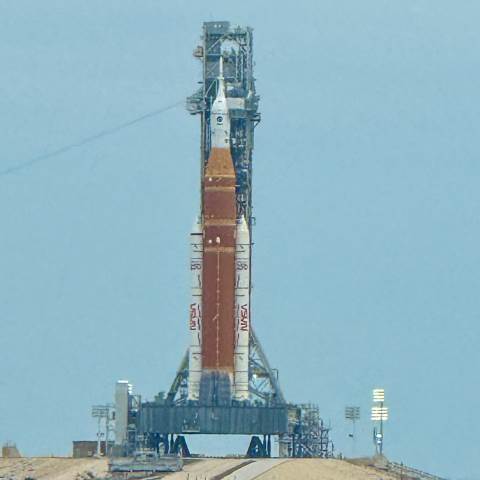
We stood together facing Launch Complex 39B. In the distance, rising above the horizon, was the Artemis II Space Launch System rocket. The SLS rocket, crowned with the Orion capsule, stood poised against the sky, awaiting its early March launch. For the first time in more than 50 years, humanity is preparing to send astronauts around the Moon again.
The Artemis program represents a bold new chapter in space exploration. Named for the twin sister of Apollo in Greek mythology, Artemis builds upon the legacy of the Apollo missions while pushing further. Artemis II will carry astronauts on a lunar flyby, marking the first crewed mission beyond Earth orbit since 1972.
For our students, this was not abstract history. It was REAL. The rocket was there. The launchpad was there. The engineering was visible, tangible, immense. They asked thoughtful questions. They stared longer than they expected to. In those moments, science was not just a subject. It was possibility.
There is something deeply powerful about standing where history has happened and where it is about to happen again. Launchpad 39B once sent Apollo astronauts toward the Moon. Now it stands ready to send Artemis astronauts back.
As educators, we hope for experiences that stretch our students beyond the classroom walls. We hope they see that what they are learning in math, science, and history is not confined to worksheets or assessments. It lives in steel and fire and imagination. It lives in engineers and astronauts and dreamers who once sat in classrooms just like theirs.
Our sixth-graders will return to routines. Tests will be taken. Projects will be completed. But years from now, many of them will still remember standing shoulder to shoulder under the Florida sky, looking at a rocket that will carry humans back toward the Moon.
Some of them may choose careers in engineering. Some in science. Some in fields we cannot yet imagine. But all of them now carry a memory of possibility.
And that is what field trips at their best can do.
They give students a glimpse of something bigger than themselves. They connect generations. They remind us that history is not finished being written.
As our bus continues home, I cannot help but wonder which one of these sixth graders might one day stand on a launchpad not as a visitor, but as part of the team that dares to go further still.